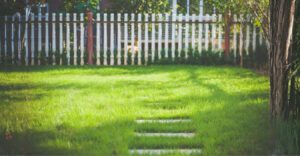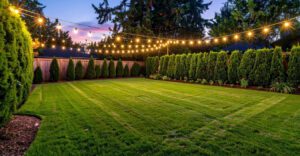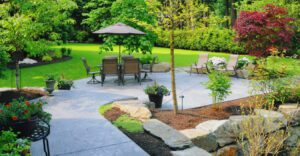
You know that feeling when you pull into your driveway, and something just doesn’t feel right? Your yard isn’t ugly, but it’s not very impressive either. It just sits there, flat and forgettable. It’s even a little embarrassing when the neighbors’ landscaping is on point.
Here’s the brutal truth: a basic yard isn’t just an eyesore; it’s actively costing you. Your property value takes a hit, your outdoor space goes unused, and every weekend you spend trying to “fix” it with random plants just makes things worse.
At Rich Landscaping, we’ve spent over 40 years turning uninspired outdoor spaces into landscapes people actually want to spend time in, and we’re sharing exactly how it’s done.
This guide explains why your yard looks plain and shows you the tried-and-true landscape design principles that professionals use to make beautiful outdoor spaces that finally feel complete.
The Real Reasons Your Yard Looks Plain and Uninspired
Most homeowners think their yard looks boring because they didn’t spend enough money on it. That’s not it. Mistakes in design are to blame, and even expensive plants can’t fix them. These are the three worst offenders.
- No Defined Focal Points to Draw the Eye – Look around your yard. Where does your eye naturally go? Problem number one is if the answer is “nowhere specific.” Landscape focal points are like visual anchors—they give your space a purpose and make it stand out. A focal point could be a beautiful seating area, a specimen tree that stands out, or a water feature. At Rich Landscaping, we’ve seen how one well-placed focal point can change a yard completely.
- Random Plant Placement With Zero Cohesion -This is the most common mistake: you go to the nursery, see plants you like, and put them wherever you can. The result? A group of plants that have nothing to do with each other. When you plan a cohesive landscape layout, you need to think about how plants work together. Professional landscape designers know how to make plant communities that work together as a whole by understanding how texture and form work in landscaping.
- Flat, One-Dimensional Layouts That Lack Depth – A pancake landscape is when everything is at the same height. To get depth, you need to stack things. For example, tall trees in the back, medium shrubs in the middle, and low groundcovers in the front. This gives the landscape structure and depth, which makes the spaces feel bigger and more elegant.
Core Landscape Design Principles That Instantly Upgrade Any Yard
Professional designers don’t just make things up; they use tried-and-true rules that make things look good together. Knowing these basics is what makes the difference between a yard that looks good in a magazine and one that doesn’t.
- Balance and Symmetry That Create Visual Stability -Balanced landscape design doesn’t mean everything has to match perfectly. For traditional homes, symmetrical balance is a great choice. It feels more natural to have asymmetrical balance, but it takes more skill. On one side, a big tree might be balanced by a group of smaller plants on the other.
- Proportion and Scale So Features Don’t Look Awkward – When designing, proportion and scale in yard design are all about relationships. It looks silly to have a small patio next to a huge house. Yards that are small need pretty trees and cozy patios. Specimen trees and several outdoor rooms can fit on large properties.
- Rhythm and Repetition to Build Flow and Continuity – Rhythm makes patterns and movement that help the eye move through space. The sweet spot is to repeat important parts of your design 3 to 5 times. If you do the same thing too many times, it gets boring. If you do too many different things, it gets messy. Our landscape designers in Seattle use this balance to make places that feel good.
Stop guessing and start designing—here’s how professionals layer color, texture, and form to create yards that actually impress.
How to Use Color, Texture, and Form Like a Designer
Color, texture, and form aren’t just art class terms—they’re powerful tools that make the difference between a yard that’s just “fine” and one that makes people stop and stare.
- Layering Plants to Add Structure and Interest -Layering isn’t just about height—it’s about creating visual depth. Start with tall trees as a backdrop, add mid-height shrubs for structure, then finish with perennials and groundcovers. At Rich Landscaping, we approach layering with extensive knowledge of Pacific Northwest plants, ensuring visual interest across all seasons in landscape design.
- Color Theory for Landscapes That Don’t Clash – Landscape color theory goes beyond picking favorite colors. Complementary colors create high contrast—think purple and yellow. Analogous colors feel harmonious—like blue, purple, and pink. Warm colors energize spaces. Cool colors create calm. Strategic use helps you improve curb appeal dramatically.
- Mixing Hard and Soft Elements for Contrast – The interplay between hardscape (patios, paths, decks) and softscape (plants, lawns) creates an essential contrast. Modern landscape concepts embrace this balance. This is why Rich Landscaping offers comprehensive solutions—from installing fences and decks in Redmond to selecting perfect plant material.
Creating Focal Points That Stop the Yard From Looking Boring
Without a focal point, your yard has nowhere for the eye to land. Strategic focal points give your landscape personality and purpose without overdoing it.
- Using Lighting, Sculptures, or Water Features Strategically – Landscape focal points don’t always have to be plants. Well-placed lighting makes a tree the evening garden’s star. Water features add movement and sound. The key is strategy—choose one primary feature per viewpoint.
- Pathways That Guide Movement and Attention – Paths control how people experience your yard. A straight path rushes you to the destination. A curved path creates anticipation. Materials should coordinate with other hardscape elements for a cohesive landscape layout.
- Framing Views Instead of Leaving the Yard Wide and Empty – Professional designers think in terms of framed views. Maybe you have a mountain view that could be highlighted. Framing uses plants or structures to direct eyes toward desirable views and away from problem areas.
Common DIY Design Mistakes That Keep Yards Looking Amateur
Even well-intentioned homeowners make the same mistakes over and over. Avoiding these usual pitfalls will save you money, time, and headache.
- Overstuffing Spaces Without a Plan – More is not better. Overcrowding creates maintenance nightmares. This is one of the most frequent DIY landscaping mistakes we see. Homeowners buy plants based on nursery size, forgetting that a small shrub will be six feet wide in three years. Professional landscape design in Redmond accounts for mature sizes from the start.
- Choosing Plants Only by Looks, Not Function – That gorgeous plant caught your eye—but is it right for your conditions? Choosing plants purely for aesthetics wastes money. At Rich Landscaping, we know which plants do well in certain conditions because we’ve been in the landscaping business for decades. Our licensed Landscape Architect makes sure that every plant we choose looks good and serves a purpose.
- Ignoring Seasonal Changes in Color and Shape – Your yard should look good all year round, not just for two months. A lot of amateur designs only focus on flowers that bloom in the summer. Thinking about the whole year is important. This makes sure that the yard aesthetic improvement will always look good.
Transform Your Yard From Basic to Exceptional
Here’s what it really comes down to: the yards that make you do a double-take aren’t necessarily the ones with the biggest budgets. They’re the ones where someone actually understood the basics—balanced landscape design, smart landscape focal points, and proper proportion and scale in yard design. When you fix the core problems (no focal points, plants thrown in randomly, everything sitting flat), you’re already miles ahead of most neighborhoods. Landscape color theory, texture, and form in landscaping aren’t complicated once you get them. Boring yard fixes happen when you apply outdoor design fundamentals that actually make sense, not when you throw money at the problem.
We’ve been doing this at Rich Landscaping since 1981, so we’ve pretty much seen it all. Our landscape designers in Redmond, landscape designers in Kirkland, and teams handling landscape design in Seattle know what works in the Pacific Northwest and what doesn’t. We’re not just throwing plants in the ground—we’ve got a licensed Landscape Architect on staff, and we handle everything from the first conversation to the final installation. Need landscape design in Kirkland or Redmond? We’ve got it covered.
Ready to stop settling for a yard that just exists? Give us a call at (425) 222-9544 for a free consultation. Let’s talk about real backyard design upgrades and modern landscape concepts that’ll actually make a difference.